ODVA: Advisory Committee comments

Edited transcript
My name is Logan M Isaac, I was in the Army from 2000 to 2006 and got out as an E5 paratrooper and forward observer for the artillery. When I got out, I started pursuing higher education and used VA Services across a couple of different states. I landed in Oregon about a year ago and I'm really interested in the question of why some vets aren't self-identifying and I propose that there's another way to think about suicide prevention that isn't getting enough exposure-civil rights.
Human dignity is the missing ingredient for suicide prevention.
From the federal level on down, our civil rights as service members, former service members, and military dependents, are a hodge podge of poorly enforced statutes, municipal codes, etc. Here in the state of Oregon we are not protected. The closest we come is employment under ORS 659A §082. Our neighbor to the south, California, recognizes military families as a fully protected class under Cal. Gov. Code §12920. However, at the federal level veterans and military families haven't asserted those rights. We sometimes are surprised to learn that employment discrimination and housing discrimination are occurring. But we keep silent because we've been taught to “shut up and drive on.”
Human dignity is the missing ingredient for suicide prevention. I'd like to see Oregon come up to speed with California and also [for ODVA] to encourage and advocate at the federal level for not just civil rights to be passed, but those laws that do protect us to be enforced.
For example, the Hate Crimes Prevention Act of 2009 included an entire section, §4712, that extended [hate crimes] protections to service members their families, up to 5 years after discharge. The Department of Justice at the federal level does not know about this law, has never enforced it, and its agents have no idea it exists. [HCPA has] been in place since 2009 and we still haven't gotten hate crimes protections for our community. Because… domestic terrorism charges are easier to get a confession or a conviction. Hate crimes are explicitly intended to protect our entire community, so individuals are getting spot check protections but our community as a whole is falling through loopholes.
I'm only mentioning federal [protections] because Oregon doesn't have similar protections. VEVRAA is supposed to extend employment protections to Veterans. However its enforcement agency, the [Office of Federal Contracts and Compliance Program] receives more complaints from veterans than any other complainant, and has since 2004. More veterans are complaining of employment discrimination to the Department of Labor than any other complainant but veterans’ complaints are receiving the lowest record of findings of merit. Essentially the Department of Labor doesn't believe veterans when they complain of employment discrimination.
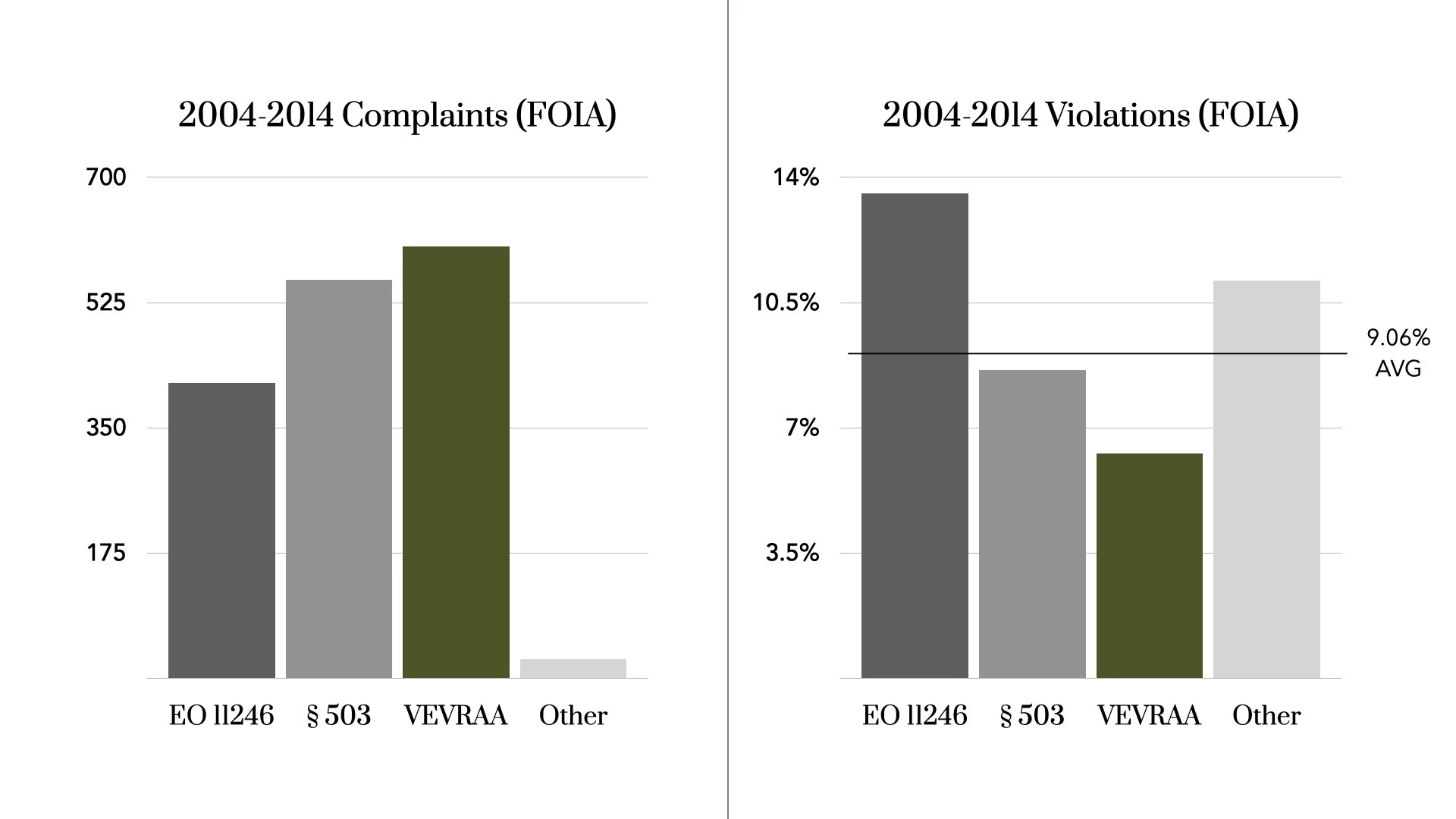
Thirteen of those complaints since 2004 have come from the state of Oregon, because Oregon does not protect veterans from employment discrimination. Oregon does not protect from hate crimes or bias incidences either, and I'd like to see that [loophole] closed. I'd like to see Oregon be an example for the federal level to not just put [military civil rights] in law, as California has, but to advocate for a comprehensive enforcement of veteran’ and service members’ civil rights to include the EEOC, which excludes veterans from its protection. The Department of Housing and Urban Developments Office of Fair Housing and Equity also excludes veterans.
An example is income discrimination; I know a veteran who used his VA disability income to apply for an apartment. The apartment manager was very formal and [had to ‘check the accuracy’ of] a federal document, the VA Disability Compensation Award Letter. An uninformed civilian held up that application for a highly sought after apartment, representing income discrimination.
Individuals are getting spot check protections but our community is falling through loopholes.
There's no protection [for veterans from income discrimination], but I think it's clear that examples like these affect veterans every day. I hope Americans and Oregonians are willing to step up to the plate and start closing those loopholes. Thank you very much.
Q&A from the committee
[Vice Chair comments inaudible]