Kingstowne Communion
The Martinian Difference
I am grateful to Rev. Michelle Matthews for inviting me to The Kingstowne Communion of Alexandria, VA to give a presentation on Martin of Tours on November 29, 2016.
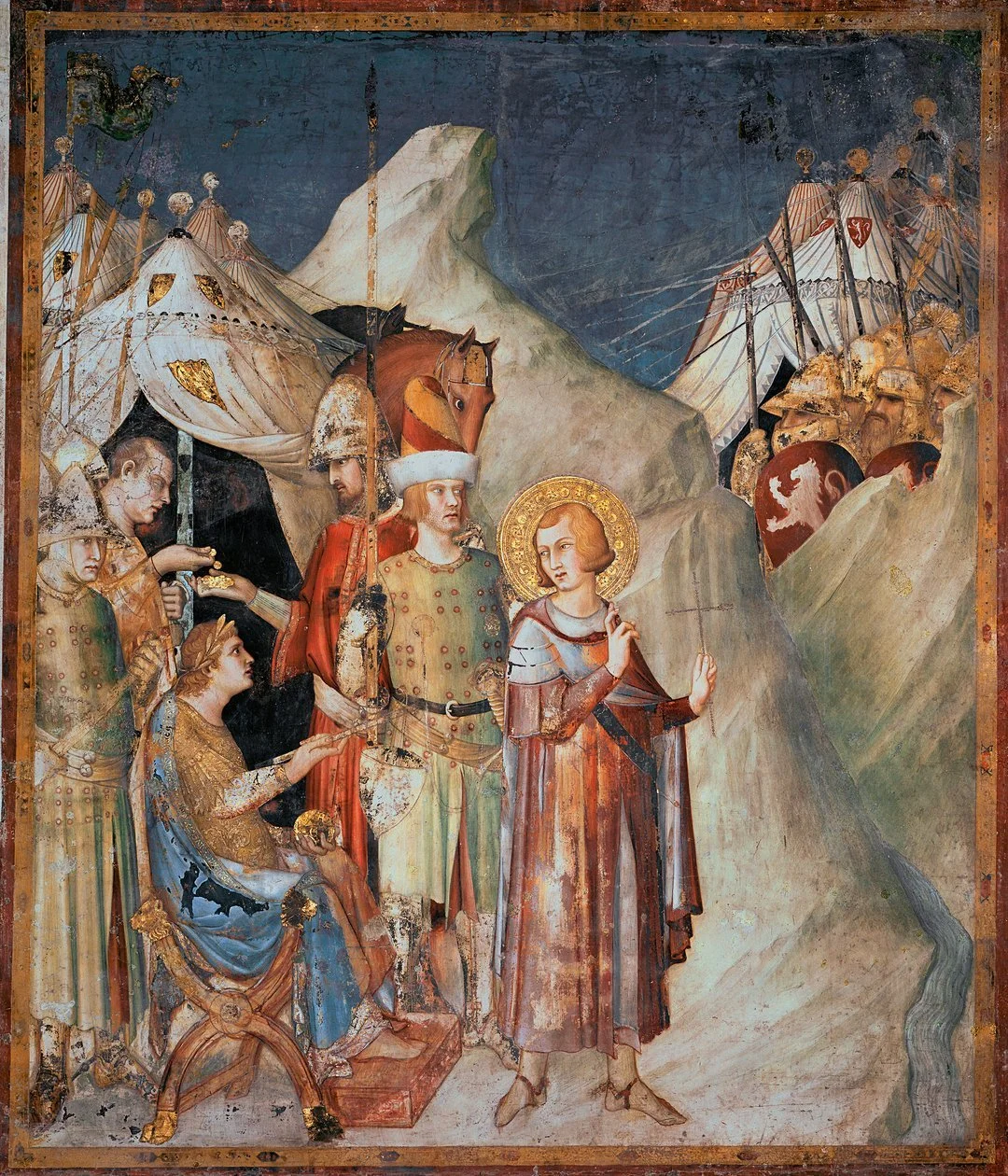
Saint Martin Renounces his Weapons, fresco in the Saint Martin Chapel, Lower Basilica of San Francesco in Assisi, Italy.
I’ve been invited here to talk about two traditions the Church has relied on to think about the intersection of faith and armed service; Pacifism and Just War. I should warn you that, although I have two masters degrees in theology, I did not initially encounter these traditions in the abstractions which are typical of formal theological education. After a 2004 deployment to Iraq, I began reading my bible in earnest and was quickly confronted by a two thousand year old question which Pacifism and Just War have each attempted to answer. Pacifists and patriots alike have thought these two traditions help us answer the Question of Killing, but theologians on both side of the ideological aisle have only really addressed the Question of Military Service. The distinction is important, as those who have served in an armed force will likely be aware.
Theologians have largely failed to think about killing in any concrete way, and the debate about whether Christians can kill is too often a debate about whether they can be soldiers. But this is a dangerous conflation that assumes every soldier is a sword wielder, and theologians are not the only folks getting it wrong. During field exercises as a paratrooper in the 82nd Airborne, I was often reminded that “every man is an infantryman first.” In other words, every soldier is a trigger puller.
At least one problem with that idea is that, as an artilleryman, it was a waste of my time and resources to pull the trigger of my M-4 carbine. If I did, I’d release a 5.56 millimeter round downrange, ideally center mass of my chosen target. But if, instead, I were to get on my radio and do my job as a forward observer, I’d send a high explosive projectile downrange 11 times larger than the grunts in my platoon were with their peashooters. So no, thank you very much, I was not a mere a trigger puller.
This conflation doesn’t only fail for artillerymen like me; two of my active duty roommates when I was stationed at Schofield Barracks told me that they hadn’t touched a firearm since boot camp. This would be the case for many Military Occupational Specialties, or MOSs, which weren’t “combat arms” specialties, such as cooks, supply chiefs, accountants, lawyers, and innumerable medical specialties. In fact, these jobs, and many other non-trigger-pulling MOSs differ from their civilian counterparts only in their workplace attire. Do civilians pull the trigger as well? In our representative democracy they might, but that’s a subject for another time…
To understand pacifism and JWT, you have to have a decent grasp on historical theology. Many historical theologians, however, paint this conflation onto the past. As I’ll describe in a moment, there is no shortage of early Christian communities which were hostile to military service, but this hostility is not found in the new Testament, which we’ll see when we get into our scripture exercise. Historical disciplines require some familiarity with languages, and one reason modern theologians fail to distinguish between the Question of Killing and the Question of Military Service is that many they fail to distinguish between the Latin words militia and bellugare. The first even suggests militancy, armed force, etc. But it is the second which actually refers directly to war. Only the most doped up, greased down, musclebound soldier of fortune in history would declare belligerō (“I wage war”). Rome was as known for living into caricatures as the modern military sometimes is, and it would be, then and now, a machismo caricature of the vocation of soldiering to refer to oneself as a pugna, or “fighter” (from pugnus, which meant “fist”). Rather, what soldiers usually said, and this was as true of the Christian military martyrs of the first three centuries in Rome as it was for dutiful pagan soldiers, ego miles sum – “I am a soldier.”
The typical way to refer to a soldier, miles, has more to do with orderly service than belligeri, Latin for “men who wage war.” If you’re familiar with the metric system, you might notice the subtle reference to thousands, milia. We see this in the organization of ancient Israelites as well, to which we often refer in English bibles as “hosts,” or “companies.” But this indicated numerical significance, not just war-fighting power.
These words are used when the Israelites prepare for battle as well as when they are determining how to fairly distribute the promised land. The emphasis is on order and quantity, not so much on their numerical strength In fact, God often reduces their ranks before battle if they outnumber their enemies. (Duet. 20, Gideon, etc.) One Christian soldier highlights this distinction between serving and fighting, between miles and pugnare.
Martin of Tours was born in 316, just four years after the Emperor Constantine had a famous vision in the midst of battle, the effect of which was the decisive end to all formal persecution of Christians in Rome. Martin’s dad was a veteran, which may have been why he was named after Mars, the Roman god of war. Being a male military brat also meant he would be obligated to serve like his father. When he reluctantly joined up, he was assigned to the unit that guarded Caesar himself, the Praetorian Guard. Just like the Secret Service doesn’t go to war very often, Martin wouldn’t have expected to see much combat.
One winter when the emperor was in Amiens, in northern France (it was called Gaul at the time), Martin encountered a freezing beggar. As an aspiring Christian, he desired to help the poor man, but had only his luxurious lambskin cape which had been issued to him. Cutting it in half, he clothed the freezing beggar and went on his way. That night he dreamt of Christ addressing the heavenly host, saying “Here is Martin, not even baptized, who has clothed me.” The next day, he goes to be baptized and becomes a Christian.
Most pacifists, including Martin’s own biographer, read this incident and think he immediately leaves the army for good. But this isn’t quite right. According to the biography, the moment which leads to his reluctant departure from the military doesn’t occur for another 20 years, at the Battle of Worms. Sulpice, his biographer, insists the episode in Amiens occurs only a few years after entering the military, which the historical record supports. However, that same historical record makes clear that Julian is not in Worms until 356. If Martin was born in 316, he entered the army in 331 at age 15. Then, 25 years later, he finds himself on the battlefield for the first time.
If this sounds like a stretch, remember – the Secret Service deployed to warzones with Presidents Bush and Obama even though it is not a central feature of their occupation. But now imagine that the men and women in black identify not as an “agent,” but as a “soldier,” because that is what members of the Roman imperial guard were. Martin could distinguish between serving by protecting the life of an earthly ruler from fighting indiscriminately in war. As Caesar Julian reviews his troops, giving them a pep talk on the eve of battle, Martin interrupts loudly;
Christi ego miles sum: pugnare mihi non licet
He distinguishes between service and fighting, saying “I am a soldier of Christ, it is not lawful for me to fight.” His service as a soldier is to Christ, and this service forbids the kind of fighting found on the battlefield. There is nothing wrong with being a soldier, and even Paul uses martial metaphors in his letters, but there is something that Christians pushback against when that service requires blind obedience and indiscriminate violence. Martin challenges the easy assumptions of both Pacifists and Just Warriors, and if you allow me to, I will literally talk your ear off about him. But I digress, so let’s return to the topic at hand.
Pacifism is the dominant view in seminaries, and although it takes many forms, for the sake of brevity we will say that pacifists object to all war in any form. The biblical basis for pacifism is drawn primarily from Jesus’ sermons on the Mount in Matthew 5 and on the Plain in Luke 6, where Jesus commanded his followers to love their enemies, bless those who cursed them, turn the other cheek when struck, and to not resist evildoers.
Those seemingly simple instructions quickly gave way to theological disputes in the early church. We know that two early theologians, Tertullian and Origen, refused to baptize soldiers unless they left the military and threatened excommunication to Christians who joined after being baptized. Because we writings of theirs like this, we can safely assume some soldiers came to be baptized and some confirmed Christians expressed interest in becoming soldiers. The term “Christian soldier,” to these two theologians at least, was mutually exclusive; you could not be both, for to be one prohibited you from being the other. The only option for soldiers, in this pacifist mindset, was being a conscientious objector.
In our own context, objection is codified in military regulations. The DoD and each branch of the US military provide allowances for service members who have experienced what these regulations refer to as a “crystallization of conscience.” If you enlisted or took a commission, then you affirmed that you were not at that time a “conscientious objector” and had never been. I, for one, didn’t know what a conscientious objector was, so I checked No for that box… A conscientious objector is someone whose “religious or moral training and beliefs” have evolved and ‘crystalized’ to the point of objecting to war in any form. Each branch has their own regulation;
Department of Defense Instruction 1300.06
Air Force Instruction 36-3204
Army Regulation 600-43
Coast Guard Commandant Instruction 1900.8
Marine Corps Order 1306.16F
NAVPERS 15560D MILPERSMAN Section 1900-020
But these words “all” and “any” are absolute terms, uncompromising in their rejection of martial violence. Some of the regulations even insist service members have a “requirement to bear arms,” a kind of weird tweak on the 2nd amendment. If you are a member of what I think is the silent majority, those who are willing to fight if a war is justified but may refuse to fight in an illegal or immoral war, well, you have no legal protection. The way the military thinks, and the way the Church thinks, you must be all or nothing, it is either obey or object.
The confusion of the Question of Killing and the Question of Military Service did not begin with the Bible, for the Bible does not assume all soldiers are inherently sinful, at least not in any way distinct from the sinfulness of any other person. The confusion began with Tertullian and Origen, who took service itself to be the morally relevant issue, not the particular acts conducted in war, like killing. Or saving your buddy’s life, for that matter.
Just War is another tradition and is only slightly younger than Pacifism. Because it is not as… uncompromising as Pacifism, it is harder to pin down. In the contemporary religious landscape, the Roman Catholic church has one definition of JWT, and the Southern Baptists have another. As a general rule, there are a handful of criteria by which individuals might discern whether or not a war is just or unjust. These criteria are often broken into two groups, considerations for politicians entering into a war, and considerations for combatants in the midst of war. Each denomination and community differs slightly in the number and type of these criteria.
Standards for entering into a just war, called jus ad bellum, include considerations about the proportion of just violence compared to the evil it seeks to overcome, that the cause for a just war be declared by a legitimate authority, that it be a last resort begun only after the exhaustion of diplomatic measures, that there is a reasonable expectation of success, and others. Those for combatants engaging justly within war, called jus in bello, require that noncombatant immunity from violence and other evils, like theft and rape, is protected, that prisoners of war and other enemies are respected, and that an individual’s violence does not exceed necessity. There is also a developing tradition of justice after war, jus post bellum, which protects defeated enemies and provides humanitarian support for civilian populations that has ancient roots but is only now being reestablished.
Some people refer to JWT as a “theory,” often as a derogatory term, but it is more appropriately called a tradition, a conversation carried on over generations which evolves as needed to fit particular circumstances. The tradition as I have described it, with more or less concrete criteria, etc. is actually very new. This form of the tradition is particularly legal in its structure and intent, and in fact that is precisely its purpose in a post-industrial moral landscape in which weapons and the capacity for destruction have outpaced political will for peace. In the 17th century, a lawyer named Hugo Grotius transformed the tradition into something that would submit to international law.
But before JWT became a legal system, it governed the religious life of knights returning from the Crusades. Thomas Aquinas laid the groundwork for medieval theology in his Summa Theologia, where you can find his formula for determining the justice of a war not for legal legitimation, but for liturgical survival. His Summa was a handbook for priests and was used in every church in Europe. One application which is relevant to our discussion tonight is its use to determine the penitential rites of returning crusaders. While Thomas provided the backbone for medieval theology, there are innumerable works detailing, very specifically, what a knight was required to do to atone for the sins of killing in battle.
For example, if you struck a man and knew he died, you could be required to refrain from communion for forty years. If you didn’t know if he died, it might be 7 years. If you were like me, and did some damage from a safe distance, then you might do 3 years of penance and one more for being a coward. There were workbooks derived from the Summa that circulated amongst priest that were called “penitentials,” and there is literally a sea of them. The Church did a LOT of Crusading.., and a lot of justifying it too. But JWT is often traced back to Augustine, in the fifth century, and he will provide a bridge not just between pacifism and JWT, but also to a totally different kind of theology we will talk about soon.
Although many Christian scholars claim Augustine was the father of JWT, he never said anything about war or violence in any organized or systematic way. In his City of God, he included a number of scattered and rather disconnected thoughts about war which he borrowed from the Roman jurist Cicero. Among other things, he advised that we should, and I’m paraphrasing here, pity the fool who goes to war and returns unchanged, who comes home without some form of “heartfelt grief” or sorrow of soul.
All jokes aside, Augustine gives us a radically different way to think about the false dichotomy between JWT and Pacifism. Contrary to the recent swelling tide of coopting Augustine in a quest to legitimate wars, or ignoring him and privileging Tertullian and Origen, we should do what he did, which was to listen to those who had done violence and work to put the pieces of their broken hearts back together. In his letters we find even more about war, mostly in letters to Boniface and Marcelinus. In fact, he dedicated his City of God to Marcellinus. We know more about Boniface, who was a Roman general serving in the provinces, where battles were frequent and R&R nonexistent.
We don’t have Boniface’s first letter, but we have all of Augustine’s responses. In them, the Bishop of Hippo responds carefully and attentively to the needs of a high-ranking soldier. We know Boniface desired to become a monastic, which was a rather subversive move championed by counter-cultural monastics who left the cities to avoid the sinful excesses and religious corruption.
Let that sink in… a general officer is asking his pastor about leaving his post, leaving civilization, and committing himself to prayer and study. Augustine discourages the idea not because he has a duty to protect the empire, but because he had a conjugal duty to his wife. He asks the career military man if he has done things that imperil his eternal soul, like mistreating his enemy or injuring noncombatants. Augustine forces this soldier to explore the actual experiences he had, rather than pull him into some abstract debate about ideas or principles.
Augustine asks us all to do the same, to remember the human lives right there in front of us. For ministers who care for soldiers and veterans, our responsibility is not to get our theology right, but to get our relationships right, to get our souls right, to bring our soldiers home, not just in this life, but in the life to come.
To conclude, I want to conduct a theological exercise. I think pacifism and just war each have value, but that they demand far too much of our intellectual attention. They each can reside in the land or ideas and lose sight of the reality that we live in a world in which those most directly affected by war, our soldiers and veterans, are killing themselves in greater numbers than ever recorded.
Every day, 20 veterans will take their own lives. That is one ever 72 minutes. Of those 20, about 14 identify as Christians.
It is my belief that they lose faith and hope because theologians have lost sight of what’s truly important to Christ. Jesus never stoned a heretic, he saw a human being. No matter how gung ho you are about our union, or how fired up you are about principled nonviolence, we all have a responsibility to see heartfelt grief and sorrow of soul when it looks us in the eye. To speak love to one another, we have to get out of the world of ideas and hypotheticals.
If pacifism and JWT are too abstract, then we need a more embodied way of doing theology for our military personnel. For almost a decade now, I’ve been working on creating a constructive, intellectually rigorous, and theologically nonpartisan way of interpreting scripture and the world around us from a military lens, and I’d like to try it out tonight.
The first time I was confronted by this two thousand year old question I have laid out, I was a young NCO sitting at the docks at Pearl Harbor, pulling guard duty for trucks waiting to be loaded on ships and sent to Kuwait for what would have been my 2nd deployment to Iraq. You can learn more about my journey in my book, Reborn on the Fourth of July. I didn’t get to go on that deployment, because that day on guard duty began to see I was in the middle of two very different perspectives, two traditions that have only grown apart in the last several decades of wars and rumors of wars.
To bridge the gap between Pacifism and JWT, I propose digging deeper, getting into scripture and tradition with a finer toothed comb than usual. When I started reading my bible, I identified with the soldiers and centurions in scripture. I think what I have developed is not really a ‘theology’ like liberation theology or systematic theology, but a hermeneutic . Hermeneutic is a fancy seminary word for “interpretation.” Like feminist scholarship, which approaches texts and contexts from the perspective of a woman, my hermeneutic approaches these things from the perspective of a soldier.
The kind of hermeneutic I am trying to create, then, is a particularly martial hermeneutic; one which sees and interprets from the perspective of a soldier. This martial hermeneutic can be applied not just to scripture, but also tradition, literature, theology, etc. I am still in the very formative stages, but essentially it requires a certain attention to detail that is effective most when done with someone who has some experience in the military. NT Wright taught me that theology is always done in community, so I am hoping to try a martial hermeneutic out tonight with yall.
I’ve chosen a text which I have learned has a special connection to military audiences, or should. There are a lot of other passages which I could go on about, but this one I think might be a surprise, and I haven’t shared the following presentation publicly yet, so I hope you’ll bear with me.
There are some parts of scripture that appeal overtly to military audiences or to anyone trying to think about issues important to soldiers and veterans;
David
Samson
But tonight, I’m hoping we’ll find something interesting in a text not often associated with military themes, and that is Paul’s letter to the Philippians.
Contextual Exegesis as Martial Hermeneutic – Paul’s Letter to Veterans
In Philippians 2:1-13, Paul exhorts the Christians of Philippi to be of one mind and one love. “Be uniform in your loving and thinking,” we might paraphrase. This kind of language would appeal to Christians in this place because very many of them were either veterans themselves or children of military veterans.
The town of Philippi is where Julius Caesar’s assassins, Marcus Junius (“you too?”) Brutus and Gaius Cassius Longinus fled before being caught by Caesar's avengers, Mark Antony and Octavian. In 42 BC, the Battle of Philippi raged between a number of Roman legions loyal to either to Octavian or to Brutus. The victory went to Octavian, and the assassins and their troops were annihilated.
It was customary at the time for entire legions to be raised and retire together. If their service was especially noteworthy, they were given plots of land and some money, the equivalent of modern veterans benefits. Octavian became Caesar and retired most of the 28th Legion there in Philippi not long after the battle. In honor of their retirement, the city was renamed Colonia Victrix Philippensium, or "Victory Colony, Philippi." Twelve years later, in 30 BCE, Octavian retired more veterans, this time from his secret service unit, the Praetorian Guard.
Paul references this unit in 1:12-13 "I want you to know, beloved, that what has happened to me has actually helped to spread the gospel, so that it has become known throughout the whole imperial guard and to everyone else that my imprisonment is for Christ." This verse is the only place in which this reference to the elite security force occurs in the New Testament.
It’s noteworthy that Paul doesn’t reference it disapprovingly, either, because Paul knew his audience would see the protection of Caesar’s life as a good thing. In fact, many of them would have had fathers or grandfathers who served in that very unit.
Paul’s letter to the church in Philippi is usually dated in the late 50s AD, just 80 years after Octavian’s personal security detachment was retired there. Roman citizens were at the top of the social hierarchy in the provinces, so it is safe to assume the land stayed in their family, and may have even been inhabited by the very next generation of those who had known the Roman military establishment so well. In fact, the town was ruled by two military commanders called duumviri appointed by those in the imperial capitol, and was known informally as a “miniature Rome.” Any church born in Philippi would have identified very strongly with the military culture and customs of the time.
Paul is writing to a military town, and he knows it.
We must not read Paul’s address as just another letter to a house church on the outskirts of the empire. Paul is not writing to some relatively homogenous group that happens to be a bit more northern than the rest. Luke refers to Philippi specifically as a "Roman colony" in Acts 16:12 and it is the first place Paul preaches on the European continent. In fact, it is where Paul and Silas are imprisoned and a Roman soldier tries to kill himself for failing at his job of keeping them secure when the earthquake miraculously frees them.
In writing to Philippi, Paul is writing to a military town, and he knows it. He uses language with which soldiers are intimately familiar. Paul knows that soldiers count it a "privilege" to "[suffer] for" others (1:29), and refers to Epaphroditus as a "fellow soldier" (2:25) who Paul compliments by saying "he came close to death for the work of Christ, risking his life." (2:30) Soldiers who are trained in the value of obedience would be encouraged by Paul's reminder "just as you have always obeyed me...work out your own salvation with fear and trembling." (2:12)
Rank also plays an important role in his letter to them, reminding officers and enlisted alike that "If anyone else has reason to be confident in the flesh, [he has] more: circumcised on the eighth day, a member of the people of Israel, of the tribe of Benjamin, a Hebrew born of Hebrews; as to the law, a Pharisee." (3:4b-5)
What is unique here is that Paul flips martial meritocracy, insisting to the rigidly hierarchical veteran community that "whatever gains [he] had, these [he has] come to regard as loss because of Christ" (3:7) - it is no longer about acquisition and prestige in the empire of God, it is about forfeiture and humility.
Thanks to Roman roads across the empire, the Roman military was very mobile. Soldiers in most any unit would have been familiar with tactics used in provinces known to be rather hostile, like Judea, where it was standard operating procedure to be dominating and in charge. When Paul admonished the descendants of this community to consider not being the top dogs, but to rather “consider others better than yourselves,” it might not have been the easiest pill to swallow. To a community accustomed to godlike status, to forcibly bending the insubordinate indigenous knee, Paul’s letter insisting that “every knee should bend” (2:10)… and “every tongue
confess that Octavian Jesus Christ is Lord” (2:11) probably carried a little sting. As to the Enemy soldiers are so accustomed to engaging, "their glory is in their shame; their minds are set on earthly things." (3:19) As for the veterans and their descendants in Philippi, they know what is to stand "firm in one spirit, striving side by side with one mind" (1:27) because they first learned how in their military training. But the letter to the veteran colony at Philippi is not the only place that soldiers have a part in the story of our faith, and it will not be the last. What is God saying to and through military communities of our own day? Let me know what you think!