Narrating War in Seminary
A panel held October 25, 2011, at Duke Divinity School featuring Logan M. Isaac, Andrew Bell, Warren Kinghorn, and Stanley Hauerwas. Scroll down for an AI-generated transcript and a gallery of photos taken by Tyler Mahoney.
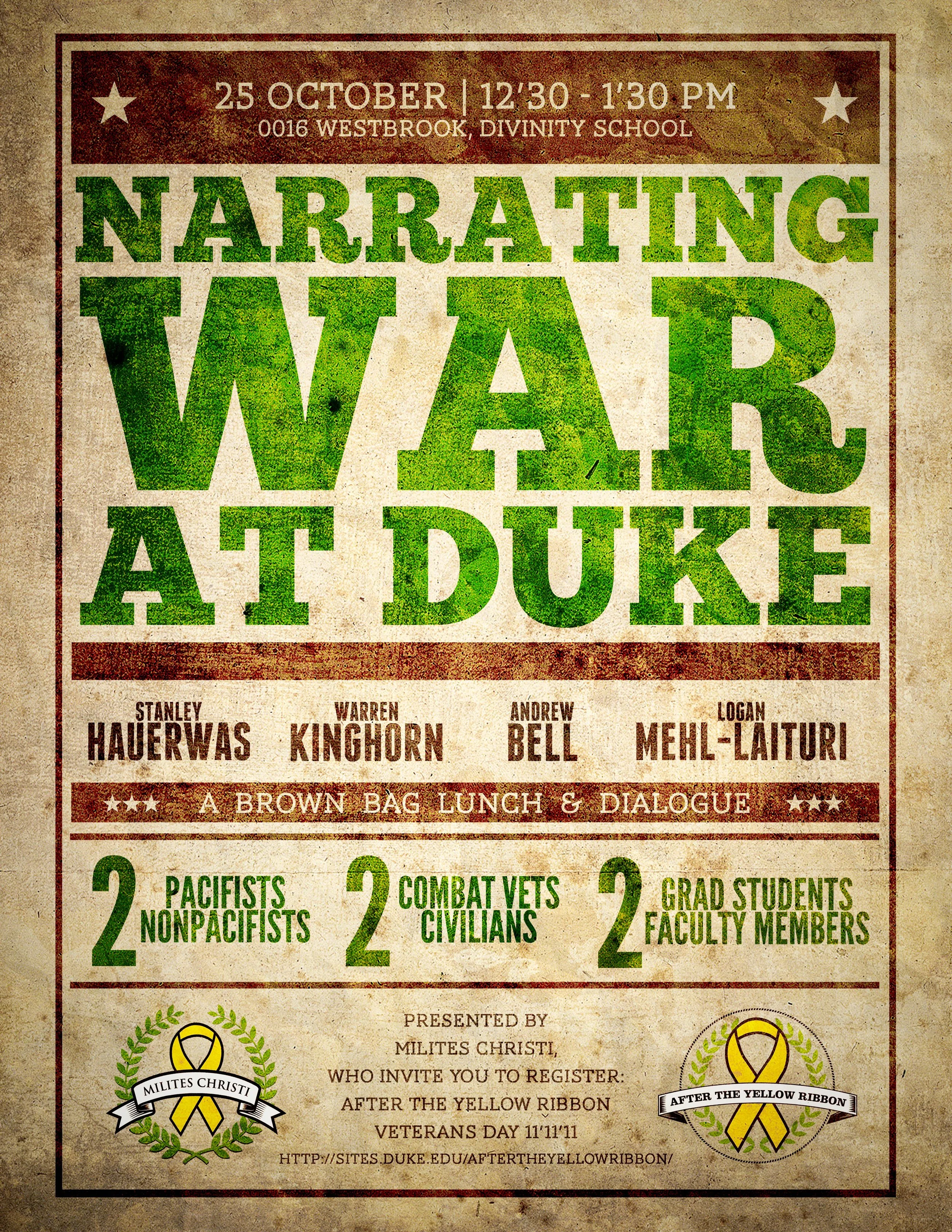
Alaina Kleinbeck: Good afternoon everyone. My name is Elena Kleinbeck and I am the co chair of a new student group here on campus at the Divinity School called Miletus Christi. The group is that name means Soldiers for Christ and the group is geared towards promoting a conversation between practitioners of all disciplines.
From music and the arts, theology and mental health to speak to the tragic epidemic that we have in our community. our country with the high rates of soldier suicide high rates of prescription drug and alcohol abuse, and a general consensus in society that our soldiers are damaged goods, and we believe that to be false and so we believe that society has The responsibility to acknowledge and confront the moral fragmentation that happens to our soldiers and our veterans in war.
And so we are seeking to cultivate conversations between academic, theological the church, martial communities, so that we can come together and build. be faithful presence to the people that serve our country in the military. On November 11th and 12th, we are going to be convening a conference called After the Yellow Ribbon.
You can see the site here. It's available on the Divinity School website. This conference is the very first event that we, large event that we are, It is available to military service members, community members, and to students. Not just students of the Divinity School. And so we ask that you come and you consider joining us for that event.
You can register for that event. It is 20 for service members and veterans. It is 25 for students and 35 for community members. On, it is a Friday night and as part also we are in dire need of volunteers. After the Yellow Ribbon is an entirely student led venture. There are no professors, there are no people sitting in offices promoting this event.
We gather together as students and plan every piece of this. We need your help as our fellow students to make this conference, this event, come together for the benefit of our communities. If you are interested in that event. I have some people that are going to be passing around clipboards.
The first page is to become a member of our email list for Militus Christi, and if you sign and put your email on there, then we'll send you updates. We promise that they'll be substantive updates, not just, hey, how's it going? And then, the second is an actual volunteer sign up sheet. I have a couple of the volunteer roles listed here in orange on both sides, ushers and greeters, tickets and tablers, and liaisons to all of the speakers that we have coming. We have a large variety of speakers that you can learn all about on, on our sites page. So at sites. duke. edu slash after the yellow ribbon, you can learn and see videos from faculty members, learn about the presenters that we have coming, and hear about the conversation that we will be promoting.
With all of that preface I would like to welcome you to coming to our brown bag session this afternoon. I would like to reiterate that our group is promoting a conversation, not a debate, not a fighting match. We are here for people. We are here to promote the spiritual and mental well being of people, and so I ask that when we open up for comments that you direct your intentions towards conversation and not towards debate.
With no further ado, I would like to introduce our panelists that we have gathered today. Our first panelist is Warren Kinghorn. Dr. Kinghorn graduated in 2002 from the Master of Theological Studies program at Duke Divinity School before heading to Harvard University for an M. D. in 2003. Returning to Duke in that year, he defended his Doctor of Theology dissertation entitled, Medicating the Eschatological Body, Psychiatric Technology for Christian Wayfares. He currently serves as a Staff Psychiatrist and Director of Psychiatric Emergency Care at the Durham VA Medical Center and Assistant Professor of Psychiatry and Pastoral and Moral Theology at Duke University Medical Center and Duke Divinity School. His research focus on the, his research interest focus on the practice, of Christian Religious Communities and Caring for Persons with Mental Illness.
Our second panelist is Dr. Stanley Hauerwas, the Gilbert T. Rowe Professor of Theological Ethics at Duke Divinity School. He has sought to recover the significance for the virtues for understanding the nature of the Christian life. This search has led him to emphasize the importance of the church, as well as narrative for understanding Christian existence. His work cuts across disciplinary lines, as he is in conversation with systematic theology, philosophical theology and ethics, political theory, as well as the philosophy of social science and medical ethics. Dr. Hauerwas has earned his B. A. and from Southwestern A BD, MA, MPhil, and PhD from Yale.
He was instructed, he has instructed a number of current and former service members as advisor for their thesis and dissertation projects. And his latest book is entitled, War and the American Difference, Theological Reflections on Violence and American Identity. This book is available in Cokesbury along with other books from our presenters for After the Yellow Ribbon.
Andrew Bell, our third presenter, is a third year PhD student in the political science department. His research examines ways to limit the targeting of civilians in war. He has earned an MTS from Duke Divinity in 2008 and served in the US Air Force for 10 years as an intelligence officer. Andrew is currently a major in the U.S. Air Force Reserves. He was deployed to Iraq in 2004 and Afghanistan in 2009, and currently serves as the president of Duke Vets, a graduate and professional student council group.
Our final panelist is Logan Baloturi. student at the Divinity School, where he is focusing on the role of conscience in Christian faith and national service. He was deployed in the infantry platoon to Iraq in 2004, before reluctantly, before he was reluctantly discharged from active service as a non commissioned officer in the army. After having requested status as a non combatant, con conscientious objector, which would have allowed him to return to Iraq without a weapon. He'll be publishing a book next year with InterVarsity Press titled Reborn on the Fourth of July, The Challenge of Faith, Patriotism, and Conscience. Please welcome them.
Dr. Kinghorn will begin. Each of our panelists will be given five to ten minutes for discussion. And then we will open it up for comments and questions.
Warren Kinghorn
Thank all of you for being here today. This is a great turnout and a great opportunity to have this conversation. I'm going to be the first speaker and say a few introductory comments to, and make way for Dr.
Harawas and also for our two veteran presenters. I am not a veteran myself although for the last several years I've had the privilege to work as a psychiatrist at the Durham VA. Medical Center, which many of you have probably been to, or at least have driven by, right across Irwin Road from Duke Hospital.
And in that capacity I've really been gifted by many people who've come through and who've spoken with me along the way to learn a lot more about the military, a lot more about the military culture, and a lot more about the experience of going to war. than I ever would have known as a civilian who had never been in the military.
That doesn't make me aware of these kinds of things as I would had I been in the military, but it's something that I receive as a gift, in which I'm glad then to be a part of efforts like this to try to encourage conversations and encourage us all to be able to listen to what veterans have to say to us.
My work at the VA hospital as a psychiatrist has made me increasingly aware of the powerful way That military training, and especially the experience of war, is not just a job. It's not just something that you do for to get benefits or to put on a resume. But it's a particular kind of personal and moral formation.
And that not, that doesn't apply just to the experience of going to a combat theater and actually engaging in combat with with an enemy. Even the process of basic training in the military is very important. involves becoming a certain kind of person. Kind of person who knows what it means to exist under very specific structures of authority.
And who is able to act and to react in certain ways when needed. Who's able to develop deep trust with both those who are in command and also with those to whom one is responsible. And and that has particular kind of virtues associated with it. It also has particular kind of vulnerabilities associated with it.
Soldiers are trained not just to do a job, but to become certain sorts of people. And when soldiers go to war, many learn to see and to inhabit the world in a way which is transformed and sometimes irreversible. And that applies not just to the experience of the world in the context of combat. But it applies to the context of how one interprets North Carolina or the United States when someone comes back from, say, Iraq or Afghanistan.
That leads to the subject of our conversation today and about the presence of veterans in the church and also here at Duke University and specifically here at Duke Divinity School. I'd like to just make a couple of comments about two aspects of this. One is that the church and Duke Divinity School need Veterans in our midst, and need to be able to listen openly and attentively to veterans.
Now, in my experience, and I think this would not be, I wouldn't be the only one to say this, veterans can often bring perspectives that make us uncomfortable, that are not easy to listen to, that are not easy to sit and have a conversation with. And it can make us squirm, and we instinctively, I think, those of us who have not been in the military often want to hide from the the kind of the raw presence of what veterans sometimes have to say about their experience of war, and about the way that they understand the world having been to war.
And I want to give you an example of something that a veteran who was in the past a student here wrote to me a few months ago, and I'm quoting this with his permission. He said, for example, Soldiers stand up for our country and do violence for the freedom of others. They cannot afford to care about the things they fight to protect.
They have to come home and listen to people that have been spoon fed milk and honey their whole lives, tell them everyone can hold hands and love each other, and that it's okay to feel wounded. That's disingenuous, because it ignores the fact that Satan is in control of a fallen world that Christ alone can redeem.
Man is fallen, depraved, and selfish, myself included. Honoring soldiers without candor isn't worth it. It's called placating and assuaging liberal guilt. This soldier also wanted me to say here, when I asked his permission to Quote him that to remind people that that this centurion in Acts was one of the first Christian converts and there's no explicit prohibition on his military service.
My reason for quoting this is not to say that this particular perspective that I've just read is immune to discussion or immune to transformation or is somehow beyond our ability to engage. As a community, but rather that this is a perspective that many people in this room, many people trained at this Divinity School would instinctively recoil from, and would would not sometimes want to engage in its presence.
And yet, we absolutely have to. We absolutely have to, in part, because people in our community have embodied this kind of experience, and also because people in the churches that you all as Mediterranean ministers will serve in those that we, in the churches that we involve in now, have absolutely had the experience of having been to war and learning to see the world in very particular terms.
So the question before us is, will we pretend that the kind of raw experience of having been to war doesn't exist and hide ourselves from it, or will we renounce the privilege of Ignorance, the privilege of innocence, that those 99. 5 percent of us in the American population that have not been in the military and have not been in a combat theater can choose to inhabit by simply turning away.
Will we renounce that and engage the the testimony, the the experience of folks that have been formed in these ways as it is, clear eyed, without any sense of deluding ourselves? But that's only one part of it. The church and this divinity school need to listen openly and attentively to the experience of veterans.
And I would say, by the way, that all, that one of the things that you will learn if you work and interact with veterans, and those of you who are veterans in the room know very well is that people in the military are all different kinds of people. The military is a large and complex organization.
Veterans are not, don't all march in step with each other. Most veterans are profoundly proud of their military service. But not every single one. Most feel very strongly that the war effort that they participated in was itself. justified, but there's a lot of disagreement about what that means and about how that's interpreted and many veterans bear the very physical and psychological marks of combat that we recognize as post traumatic stress.
Veterans, though, also need the church and the Divinity School. No experience, including that of combat veterans, is self interpreting. All of our experience as humans and as Christians can and must be shaped within the language and practices of the church. But they're not likely to be shaped if the church relies on pious kind of rhetoric or turns away from the lived experience of veterans in an effort not to confront what veterans have to tell us.
The church and churches and this Divinity School can be immensely helpful to veterans in our midst by helping veterans to, to go on, to find ways to make sense of the experience of war and to make sense of the experience of living in a culture that often turns its head to war even as it sanctions it.
And that is absolutely what the church should be about, but this can't be done unless the way that the church narrates war. is theologically complex and realistic enough to name the realities of veterans experiences. If someone comes back from Iraq and they are faced with a Christian who attempts to, to overwrite their experience, to name what they've done in ways that don't meet what they saw and felt on the ground in Iraq or Afghanistan, for example, it's not likely to be transformative either for that veteran or for the community in which they're a part.
So how can we together, come together to narrate veterans experiences in these ways?
Stanley Hauerwas
As many of I'm a pacifist, and that immediately makes it sound like that you're in the business of blaming people that go to war. And I've long thought that you're not going to do. anything about war. You can talk all you want to about the ethics of non violence or the ethics of just war.
You're not going to make any progress until we all acknowledge that we're culpable. for the continuation of war. And what we ask, therefore, of people that participate in war, those of us who do not, must know how to hear what they have to tell us in a way that we're out of the brain game. So that there is the possibility of knowing how to say I've killed without having to justify that in a way that will produce future wars.
So I've tried recently increasingly to think with warriors. And in particular, to think about the sacrifices we ask of people that go to war. It's not simply the sacrifice of the possibility that they will lose their life, but the greatest sacrifice we ask of people that go to war is their sacrifice of their normal unwillingness to kill.
Now, that creates a, the sacrifice for normal unwillingness to kill. That makes war, I think, an extraordinary moral experience. Indeed, for many people that participate in war, I think it is the most decisive, transformative, experience they will ever have in a manner that makes the church And what we do in the church sound trivial.
And I want to illustrate that by reading you a few passages from Carl Melantes. Who many of you have read perhaps Matterhorn. But he's just published a new book called What is it like to go to war? And I start with passage where he describes an extraordinary experience.
It is, he says He's talking about, he's been home from the war for some time, and he's cleaning out a basement, and he said, and he was reading a paper he had discovered, and he said, I was about to toss the paper aside when I noticed the date, 1926. I sat there stunned. The news was 50 years old, and I hadn't even noticed.
I'd apparently been stuffed, it had apparently been stuffed in the wall I'd opened. Then I started laughing at myself, at the whole situation. Suddenly everything seemed so trivial. Me trying to fix up this old house, my job, the news, marriage, history. Everything. There I was, in the basement of my new fixer upper, with no particular place to go.
It's saying that nothing, absolutely nothing, could stack up against the intensity of war and war's friendships. And then, in a wonderful passage, in Matterhorn, he talks about what those friendships are. They had been ordered to retake the Matterhorn, and and they had been decimated already. He says, when the fire, they're going up, he says, when the fire erupted from the empty bunkers, everyone wanted to crawl underground.
Several kids, in fact, went down on their knees. I had the others done the same, the attack would have stopped. And the outcome would have been a disaster. But the attack went on. Not because of any conscious decision, but because of friendship. Jackson, who was African American, went running forward more to see if Fra Fracassio was alive than for tactical reasons.
Vancouver, who was a Canadian. Vancouver saw Jackson heading up for the lieutenant and decided that even if the platoon were in a hopeless shit sandwich, he'd be goddamned if he'd let Jackson run forward alone. So he kept going. Connolly seen Vancouver charging forward did exactly the same, although his mind cried out to him to merge with the great welcoming earth beneath his feet.
He wouldn't abandon a friend to go it alone, neither would any of the others. Jackson, who had been nicked on the arm by the concentration of fire on Froskill, saw Vancouver surging ahead, shell casings flying from his machine gun. Jackson couldn't let him go alone, nor did he see any advantage to trying to crawl back through the wire.
He kept fronting forward, though forgetting to fire his weapon. You've got, you, it's compelling. Indeed, as you read novels like this, you're so taken by the sheer destructiveness and the beauty of the destructiveness, you can't withdraw from it. And that's the reason why war is more important than Christianity today.
Because it's so completely sacrificial. And what in particular is so powerful is how many people in war discover they like to kill. And the discovery of the fact that you like to kill is so devastating. And yet, it needs to be acknowledged. Orlant says, There is a deep savage joy in destruction. A joy beyond ego enhancement.
Maybe it is the loss of ego. I'm told it is the same for religious ecstasy. Now, how, as Christians, we are to Engage in conversation with people who have sacrificed their normal unwillingness to kill, and yet fear saying it is, I think, one of the great challenges before us. And it, he says. PTSD, so often times, is just the mere fact that you can't talk about what you've done.
And that's what Christians surely must be able to do as people who also know that we are not immune from the law of killing. And that's why we have to know how to be common people in a manner we will not have to pass on that love to future generations.
Andrew Bell
Afternoon everyone. Thank you so much for coming out. I'm Andy Bell. As was noted in intro I'm actually at the in the doctoral program over at the political science department. I was in, in the MTS program here back 2006 to 2008. And had a chance to think about a lot of these issues before getting deployed.
Following my time here in the MTS program I wanted to, yes. So I'm going to take a little bit of a different tack here at the start. I wanted to humanize this a little bit to keep this from just being an abstract discussion. So we could really see who we're dealing with in a way and have a better sense of what we're talking about when we talk about, who's doing this killing, who we are that we need to be caring for as Christians.
These are just a few photos that I'm going to show up here. This is from my time actually on my way out of Afghanistan. In 2000, in 2008, I was deploying back through Manas Air Base, which is the main air base that funnels people in and out of Afghanistan. These Marines here were on their way in. And if you recall, 2008, 2009 is when the surge was occurring.
And so these were actually the troops that were responsible for going into the south of Afghanistan, which was at the time, basically known as a, as Indian country. It was not touched by by any nationals, government. It was all Taliban controlled. A very dangerous place to be. It's hard to see, I think, probably, but if you can tell, it's not the best photo, but they are generally about 17, 18, 19 years old to a T.
And their leaders, the ones that are in charge of them, are the old men of 21, 22 by and large. And very young group of guys who were basically, had come right out of high school, and were being sent probably to the worst possible place you can imagine, to, in essence as as Dr. Harawas and Dr. Kinghorn have said, put their moral development in jeopardy and sacrificed themselves morally for, in essence for us and for what the nation had called them to do.
To humanize it a little bit further, these are a couple army troops that I had met while I was there. This is actually in a safe house outside of Kabul. The, let's see if I can use the pointer here. Right here, this is Eric. He's a captain a jovial looking fella. They, they look friendly, but they've also got all this stuff on where they could just kill you with pretty easily.
So it's an interesting dichotomy. But this is Eric. He was an army captain. He had been, this was his, I think, second tour in Afghanistan. He had been in Iraq just prior, probably a couple years before that. He had actually been shot through his body by an American army tank shell. Not, I'm not talking about bullet, I'm talking about actual shell.
It penetrated his body, ricocheted around. He was basically not a full person when that had finished. And yet and the doctors had said he, there's no way he was to make it. He came back out, made it through and decided he wanted to redeploy again for a number of different reasons.
This is Sergeant Lute was also in a number of deployments to Afghanistan already. He had failed marriage behind him, but he wanted to stay in the Army because of what This is Francis. Interesting name based on the thuggish look he's got there. I was intimidated by this guy when I first met him.
Come to talk to him, he's a really nice guy. Come to talk to him he's just turned 18. Had just graduated from high school about six months before I, I met him. And yet here they all are and they're doing some things that probably they don't necessarily want to tell their mothers about or their wives about when they get home.
This is just an interesting little tidbit I want to toss out there. This is special forces transit housing, typical military setup. You got some weapons there in the background, if you can see, and some ammo and gear and whatnot. It looks very hardcore. And then you pan to the left a little bit, there's a the Incredibles beach towel next to a Mark 19 grenade launcher, which is probably the only picture you have in the world of those two items together.
But to me shows the interesting dichotomy in a way. If you have these, a very hardcore natural born killer, so to speak, in the special forces, and yet, they've got probably a family back home that sent them this towel. It's in touch with sort of this more softer side of American culture from which they just came.
And finally as being Divinity School audience generally, I wanted to toss this up here. I found this extremely interesting. This is it's a quote from Isaiah 6. It's or it passes from Isaiah 6. It's painted onto the wall of a special forces compound in Kandahar Afghanistan. And you can read it.
Whom shall I send and who will go for us? And I said, here I am, send me. I found this extremely interesting, especially having just come from Duke Divinity School, right? I learned very strongly while I was here that we keep God and country separate in a way. We believe in Christ, we serve the country, but we serve Christ ultimately.
This is interesting because there's a dual message that I found in it. On the one hand It's easy to look at this and say we're they see themselves as doing the work of God. It's a very crusade kind of mentality here. And to some extent that's true. I think a number of folks there thought maybe they were crusading to do what was right, to serve in George Bush's crusade for democracy and peace.
The other way of looking at this, though, is that these are people who truly feel called to serve. And they're serving for different reasons. And they're serving under different circumstances, but in essence they're serving and in the process they're putting themselves in a lot of jeopardy physically, but also particularly morally as well.
And it's this moral trauma that they face that I really want to highlight. Not everyone who serves in the military is a frontline troop who's out there shooting the weapons at the Taliban. There are quite a few who are. Logan has had that experience of having to really put himself in some physical danger.
Which is something that I think is just one of the ultimate things to, to ask someone to do for you. But up and down the line, even people who are serving perhaps not on the front lines, They may not be facing combat danger every day, they may not be getting shot at, they may be just serving inside the wire as I've done much of my time as an Air Force officer.
But the whole operation, the whole experience is tinged with this moral trauma. It's it's hard to explain until once you get there. The whole operation is truly about killing people. Not always in a, usually not in an insidious way, but that's in essence what we're asking these young men to do.
You saw that 18 and 19 years old, they're right out of high school. And yet they're going to do something that's going to forever change who they are. It's going to impact who they are as Christians or as, as people or whatever faith that they believe in. It's going to impact their family lives.
It's going to impact all, every aspect of their lives from here on out. And it's because they're doing it because they feel as if they are serving, by and large. And they're doing it because we asked them to in a sense. I'll I just want to highlight a couple of things that bring this out in a way.
When I was in Afghanistan, I worked in a, the headquarters element of the special forces in Bagram Air Base. And that, we were in charge of targeting Taliban networks while we were there. The we were probably, as I tried to explain to my wife, she didn't believe this very often, but I tried to explain to her, I was probably safer there, literally, than I was walking around the streets of America, walking up and down 9th Street and getting run over by someone speeding down the road.
We had walls around us, fortifications extremely safe environment for someone behind the wires. I'm quiet. The moral trauma, the moral sacrifices that were being, that the people who worked there were being asked to make, I can't capture in words what it's, what it does to them. So I'll just offer up a couple of stories here.
The one is basically we were in charge of targeting Taliban networks. After a while, you start doing that, you stop seeing people as people, you start seeing them as targets. And so they become targets and it's almost like you take on this hunting mode of thinking.
You're hunting for, you're no longer hunting for people, you're hunting for, and after a while you get in that mode and people start you'll, in the intel headquarters, you start hearing people singing songs about which target that they want to kill. And you have to stop yourself and think, wait, I'm, this is someone, this is a person I'm talking about here.
This is this is someone who has a family, probably. This is someone who has a life back home. They're a human being, and yet, they've become a target to you. , yeah. Probably this was best captured by on, we would have augmentees such as myself rotate in and out of the out of the headquarters element.
And one of whom had served, she was a 19, almost 20 year old Navy petty officer. She had served quite well. She was rotating back to go home, and we all gave her sort of a thank you, goodbye lunch, and we're sending her off. And she said, at the end of her thanks, she gave her a little speech, and she said, I've had such a great time here.
I just can't wait to come back and start killing people again. And that just really was jarring on my ears. I know six months prior she probably hadn't spoken like that, but that was the mindset that we were in there to hunt targets. At the same time, I want to show that we would have these TV screens up on the wall, and we would have, the predator feed would take TV pictures of who we were tracking when they were trying to attack them.
And at this one time we were actually about to drop a bomb on a Taliban member. And, and just as he was as we were about to get him in his car, this farmer has walked into the screen down, say, the lower left hand screen as we were watching this. And so here we know this bomb has been dropped.
It's in the air. It's on its way down. And this farmer, who is not supposed to be there, he's completely in the wrong place at the wrong time, has now wandered into the path of his own death. He's within seconds. We know this man is about to die. The tension in that, in the headquarters element, we call it the geist, was palpable.
You could just feel the place stops because even though we were in this mode of wanting to kill our targets we didn't want to kill the wrong guys. And so there was this element of humanity that was still there. And so as we watched this man surely walking to his death, we just you could tell that just this intelligence headquarters building was just fraught with tension.
And then thankfully at the very last second, for whatever reason he looked at the car and at the, where the target was and he wandered off and just as he wandered off the bomb had hit, he was out of the screen. And when we realized that we had missed him the cheer went up inside the headquarters on that.
I mean everyone was like just so happy that we had not accidentally killed this man. There's a weird dichotomy that happens here. And I think that nicely captures what, We asked members of the military to do as part of their service, I just want to say that, I'm really encouraged that that there's such a large crowd here.
When I came back from active duty to Duke Divinity School in 2006, it was at the height of the Iraq War. Things were just not going well, and yet there wasn't a lot of talk that was happening there. I think people, it was easier to ignore it, and it was really frustrating for me. It brought about a lot of issues of anger I know that's fairly common with veterans who come back into this artificial environment.
I just want to encourage us as church members, as members of the Duke community we've got to reach out. Tens of thousands, hundreds of thousands of people coming back from these places who have experienced this. And it's not enough just to sit back and say I don't see it on the news anymore.
And that was nice that it happened, but I can go on with my own life. We have basically a damaged chunk of our society that's out there now, and we need to reach out to them to take care of them. Thanks.
Logan M. Isaac
To build up what Andrew was saying I want to call folks attention to a couple of articles I stumbled across recently in the Chronicle of Higher Education.
In August they published a report that of student veterans, nearly half of them had actually contemplated taking their own lives. And of that same group over 20 percent had actually planned their own suicide while they were enrolled in, in university. In a more broad scale and maybe more relevant to people who are not veterans themselves, or Maybe not tied in directly to the school.
We have the highest rate of soldier and veteran suicide in our nation and probably the world has ever recorded. 17 veterans every single day, as recorded in 2005, take their own lives. Active duty soldiers and actively serving National Guard and Reservists take their own lives at a higher rate in the last two years than we have experienced combat fatalities in Iraq and Afghanistan combined.
So in 2009 and 2010, more soldiers have fallen on their own swords that have fallen to the sword. And that has particular relevancy to the church, and that was intended. And just to bring it more provide an increased personal urgency. Right here at Duke Div, when I started orientation last fall in 2010 we sat in this classroom, the first year MTS and MDiv students and a Counseling and Psychiatric Services counselor spoke before the entire entering class.
And he was talking about doctor patient confidentiality for which he said trying to lighten the room for whatever reason, he said, you can tell us anything. You can tell us you kick your dog, you're cheating on your test, you're cheating on your spouse, you can even tell us that you've killed somebody.
At that point, my entire cohort burst out laughing. And I sat there in that room and realized what it may feel like, for example, LGBT community members to feel closeted. I could not share with people my experience in 2004 and the entire six years, over six years I spent on active duty in the Army. I spent several weeks trying to recover from that and get back into my studies, and I think I did okay for the first semester.
But my experience in the classroom was difficult, and it is for a number of veterans. I've heard, not just from people here at Duke and other departments, I think we got three emails yesterday alone, after the gypsy email went out, saying, yeah, I'm in nursing, I'm in the medical department, I'm in poli sci, et cetera, and it's real difficult.
In Old Testament precept, Actually, in class, in Old Testament last year I was walking to class and I noticed that for those of you who don't know, we have a war memorial in between the two chapels. And there's a panel for each of the major wars that we've been involved in, with names of those Duke alumni who have paid the ultimate price.
And there's an Iraq panel with only two names on there, which I suspect needs to get updated, but has a lot of free space on there. I was walking by there because every morning last semester, I would sit outside and meditate for a couple of minutes before I walked into class. And on the Iraq panel, there was somebody's graffiti tag.
Somebody painted on the Iraq panel. And as angry as I was, I realized that more than likely, somebody didn't say, the Iraq war sucks, so I'm going to graffiti tag on this panel with two names of people who died serving their country. It was more than likely just an open space, and oh, it doesn't matter what it really is, because I want to put my name and my tag on something.
I thought that was indicative of the larger university. Because there seems to be a general malaise. The ROTC is off doing their thing. Service members who have served, or who are reservists and National Guards, they don't wear the uniform, so we don't really know who they are. And so we can make insensitive, inconsiderate comments in the middle of class about combat service as pacifists.
And by the way, I'm a pacifist. But I also, because of my experience, I know what it feels like for a pacifist to assume that every soldier is motivated by bloodlust. I've heard that in this university. And in Old Testament precept one day there was one woman who was Pentecostal, and she said, we were talking, we were going through the book of Lamentations.
It was very helpful for me, it was toward the end of the semester, and I was actually assigned an exegesis paper on Isaiah 6. And it was very difficult for me, because he's very angry at Israel, and he's given this task of condemning them, and committing them to destruction. But this woman said, I don't know why we can't just have joy all the time.
And I don't know why we can't just come into church and clap our hands and sing about Jesus. She didn't actually say that. I'm paraphrasing, relatively critically. But I couldn't hold my tongue. I said, we can't get to that. We celebrate in a church because we know what the world is really like.
And we're only able to worship and praise and all that fun stuff because we've wrestled tangibly with what it means to live in a world with evil. And that's the gift of service members if we allow them the opportunity to share that gift with us. The task for the university, for the church, and the wider world is to make spaces that welcome something like what the church calls confession.
That is not to say that service members should be going about saying everything that happened as some kind of cathartic exhibitionism, but to say there's certain things that service members can bring to the table that we need to value, and that we need to draw out from them in ways that does not compromise their moral or mental health.
And we haven't gotten that yet. There's another article in the Chronicle of Higher Education published last month by a woman whose name I forget, Joyce something, I think, and she said the title was, Why I Can No Longer Teach Military History. And she said she had all these military members, military veterans, family members who were coming up to her and describing some of these experiences they had and some of the pushbacks that they had with some of the content of her class.
And she decided, her thesis was because I'm not trained as a psychiatrist and because these experiences continue to be brought forth in the classroom and in my office, I can no longer engage with it. And that's why I put the hashtag up there is fail. That's my own personal opinion. I don't think that's the answer.
There was another article rather ironically written over a year before that, titled Teaching Military History in a Time of War. And that one I put, if you forgive my bias, teacher hashtag winning. I don't, you can't read the bit. ly links, but if you want to come down they're there. He actually was a little bit more nuanced.
I just read it this morning. He talked about how these are part and parcel to teaching. How is it that, how can he talked about a young man in his class who lost a brother in the midst of teaching about war. in America. And he had to, his brother began wearing military attire like combat boots.
He began, he wasn't able to go to the sections on the 21st century. But he did a much better job of describing the task before at least the academic field. And I think it, there's something to be learned in the church and for pastors because it's really the challenge for the church right now is how do we engage with people beyond just our beliefs and stereotypes.
How do we engage with people as our brothers and sisters? And that's something that I think the university can learn as well as the church. But I want to make sure we have enough time for Q& A. The only other thing is that I want to really hammer home that as much as military service marks a kind of difference, that should not be a difference that is, that we are unable to overcome.
As a military service member, I have something that makes me somewhat unique. that I think is an undervalued gift right now, but the answer is not to elevate it to a level that sets us above other people in the general population. The wrong answer is to venerate, blindly venerate our service members as, as easily as we might, in some circles villainize our service members.
Either of those responses, I think, prevent us and disallow us from being human beings that are capable of both good and evil. And I think that's Ultimately, our task is to remember, how do we evoke the humanity in service members? How do we remind them to be the person they were before they enlisted, before they deployed?
And how do we reconstitute that, that moral character?
Questions and Comments
Alaina Kleinbeck: Thank you to our panelists. We will post the links that Logan talked about on our Facebook page, so you can go on there today. Logan and I will do that later today, so that you can find us on Facebook. Our little address is right there. So I would like to open it up for questions, reminding you once again that we are leaning towards conversation, not debate.
Questions or comments? Also it's not, you are not recorded, and so I will have to repeat your question, so if you can keep it concise, that would be great.
Is Emma a post maritime in the military? What would you, or, who's recently came back from the military? What are some questions or just dialogue that would be helpful to have with this person? It's very practically and maybe some things to be aware of. Don't go there or
Alaina Kleinbeck: wait until they bring it up.
Andrew Bell: I'll start. First of all, that's a great question. And I think To a large extent, it does depend, too, on what type of service that they were doing. And so I know Logan will have a different take because he's worked with troops who have been a little bit more touched by the front lines.
But even in general, I would just say being open is probably the most important thing. Being willing to listen, even for folks that maybe don't feel like they've had quite that transformative of an experience they have in that process. And mostly just being willing to listen to things that they have experienced and things that they're feeling, probably the best way to go.
Logan M. Isaac: What often wants to be asked, because I think we're, at least in our society, kind of morbid, is whether or not that person's killed someone. We want to know the proximity to which they had to compromise their moral integrity. Don't ask them. If someone has done something that they regret, they'll tell the people that they feel they need to tell when they feel they are ready to tell it.
I think the task of a loved one is to make it be, without a shadow of a doubt, for them to know that you're a safe place in which to share that. That means being non judgmental. In the church, we know that God is our ultimate judge, and leave it to that. And I say that because, especially in our culture right now, it's incredibly polemicized, and so ideologies take front and center.
And so that's not to say, overgeneralize, but that's just been my experience, that people are reluctant to share because we all have our opinions, and we all seem to want to make sure that other people know our opinions. But that's not what defines relationship, I don't think. And so it's Oops.
I think what we really should be doing is thinking through ways to make that space one in which confessions can occur. Confession is a a term intention, but ultimately I think that's what it is, that, that may need to occur.
Andrew Bell: If I can just tag on something as well. Part of this discussion, we've lost sight of the, probably the other half of the equation of people who are bearing the burden.
It's the families of folks who are in the military right now the husbands, the wives, the children, parents. They don't get talked about a lot, but it is incredibly hard what they're going through. And the worst part of all is that they have to go through it from afar in a lot of ways. And they've been doing it for about a decade or so now.
I can't tell you how much of an impact this has had on friends of mine whose families have had to bear this constant, gnawing trauma that they're experiencing, this fear of what this is doing to their loved one, or will their loved one ever come home it's, the effect, the poison that it injects into relationships, It's really hard to quantify.
Being open and considerate to not only their experiences, but experiences of the families as well and offering ways that perhaps to be supportive to families is probably one of the best things we could do as well.
Warren Kinghorn: I would say, briefly, just don't make assumptions about how the person is interpreting the experience.
And specifically, I think our general cultural tendency is to have someone who we welcome back home and to say, Oh, thank you for your service. You're a hero. You were there bearing the burden for us. And to oh, and if the person is one of those veterans who actually doesn't feel like a hero, or doesn't feel like a hero in every way, then to override their experience in that way is going to make it, make them less able to be able to talk about those ways in which their experience doesn't fit that paradigm that's being put upon them, and is then going to increase senses of isolation.
Alaina Kleinbeck: Alright, we'll take another question:
Yeah my husband is an actual prisoner now. As an officer, Dr. Joseph, he, as a company of men, like Dr. Carr Ross was talking about, did enjoy their trigger time. They didn't get trigger time enough, and then get antsy and almost aggressive about getting the deployments and the missions that would leave a lot for as much trigger time as possible.
When you have these men coming back, You don't even see killing as a sin or see it. What spiritually and morally needs to happen for those soldiers to even be ready to face the deeper aspects of what's happening and the deeper damage? Just from a family aspect and the church, what are the steps that need to happen to get that person out of that?
Warren Kinghorn: First of all, blessings to you and your family and all that, and all the families that, of the company that your husband's a part of.
So your question is for those of you who didn't hear, is what happens when there are folks in the military who do find themselves absolutely captivated by the experience of what you call the trigger time or healing and then come back with that as a way of inhabiting the world and don't see any problem with that and how then to go on in the midst of that in the church and also in the culture.
Am I paraphrasing appropriately? And I don't have any great immediate answer to that, obviously, because it's complicated. But that's a difficult way. It, it doesn't it takes a huge toll over time. And or at least it can take a huge toll over time. Many of the veterans that I treat from previous wars who have those kinds of experiences will find themselves doing things like working in law enforcement, for example, because it still allows a kind of sublimated way of enacting violence in certain very controlled kind of contexts.
It's a good thing to be a law enforcement officer, but it is a way to. Be able to do that, but it continues to take a huge toll and so to be attentive to those ways that it takes a toll, that the suffering involved in that, especially involved in readjustment to civilian life, can provide little glimpses of opportunity to be able to to allow for healing to occur.
And, obviously I can't speak in specific examples, but to to use those opportunities where things just seem not to be making sense or not going well is sometimes those sort of glimpses opportunity for someone to come along and to embody, model a kind of different way of being. And I think also avoiding platitudes from the broader culture that increase that sense of isolation is important as well.
Logan M. Isaac: I might have some anecdotal things that might help. So when I was in Samara in Operation Baton Rouge in was that October of 2004 one of my friends who was in my platoon, who, when I came back we would surf together, and he was a local Hawaiian, I was at, I was down in Oahu. And it was always really difficult for me to be his friend because he's really intimidating.
He's just one of those guys that just, he's always got this air of, kind of intimidation. But of all the people, so in the midst of this some of the most intense fighting we went through, we had a mental health specialist come in at this school in Samara, and we had a little in the fighting, and he asked everybody what I was doing, and my friend's name is, I guess I gave his name is Vic.
And That's how we're doing, the typical kind of therapist questions, which is totally unexpected. And so it's quiet for a while, and Vic says out of the blue, he says look around, sometimes I wonder if, in, in the middle of all this, we're all just wearing masks.
We play this game, and we put on this show just so that we can survive and get home. And I got that sense too, like I, I looked around sometimes and thought like, when we play Halo back at, back in the hooches like, you aren't this aggressive what's going on with that? I think the problem is that sometimes you have to wear the mask so often, or the mask is, if you're told the mask is one that gains you some kind of prestige or honor, the mask begins to become you.
And when Doug Howell was mentioning that, about discovery that you like to kill, I wrote down what happens when food that's prepared for idols just begins to taste so goddamn good. And just over a year ago he and I were at Elkhart, Indiana for a conference. And I asked he and Gerald Powers, who's a Just War guy what do we do in the church to reclaim the language of virtue from the military?
Because the, it's been alluded to already, the military is a place in which particularly young men can go and feel a sense of purpose. And the church doesn't have that. We haven't done anything to address the inability of Many younger people who want to do good and want the satisfaction of knowing that they're making a difference.
But the church has lasted 2, 000 years and, God willing, will last another 2, 000. But that isn't a kind of operational tempo that we're satisfied with. And so we want to see difference now. And so the military becomes more satisfying. And we forget who we were before before we swallowed that, blue pill.
And so it's, yeah, like Dr. Kienler said, it's no easy answer. This is not something that's going to have a quick fix, but Dr. Hauerwas has said over and over, we've got to be honest as a church. We've got to be ready to call things that are evil. That isn't your husband, that's the things we are asked to do in war.
And continually remind ourselves that this is what evil looks like. And just be honest, that's why I think that's where tradition is good. It reminds us that there's something that's evil in this and we have to restrain it. Sorry, I'm rambling.
Alaina Kleinbeck: We are actually out of time. I know many of you have class and so we want to thank you for coming.
Again, we ask if you have questions and things that you still want to continue on, please register for After the Yellow Ribbon. This topic is, this, these people are extremely relevant to who we are as Christians and as residents or citizens of this country. And so we ask that you register and come and join us for much more in depth conversation November 11th and 12th.
Thanks. We'll see you then.